
As immigration enforcement escalates, popular resistance is growing
By Selen Ozturk
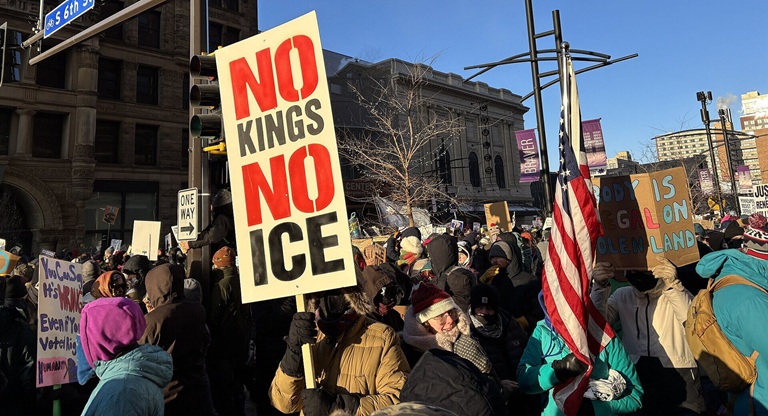
While immigration enforcement campaigns intensify nationwide, resistance is growing on both legal and grassroots levels.
This escalation reached flashpoints with the fatal shooting of American citizens Renée Good on January 7, and of Alex Pretti on January 24. Both were shot by federal immigration agents during protests in Minneapolis. In both cases, the Trump administration defended the killing as self-defense by the agent. Officials also denied state investigators access to the shooting scene.
“The killing of Renée Nicole Good illustrated what we have been saying all along: The attacks on immigrants are the tip of the spear on attacks on all Americans. This mass deportation agenda, as much as this administration had said it will only target ‘criminals’ — we are now seeing in real time that they are affecting everyone, noncitizen and citizen alike,” said Vanessa Cárdenas, executive director of America´s Voice, at an American Community Media briefing held one day before Pretti’s shooting amid widespread protests.
Metro surge
The ongoing protests are in response to Operation Metro Surge. The Department of Homeland Security (DHS) has called it “the largest immigration enforcement operation ever carried out,” involving the arrest of over 3,000 people.
The operation also involved the largest deployment of federal immigration agents in history. Some 3,000 Immigration and Customs Enforcement (ICE) and Customs and Border Protection (CBP) agents are now operating in Minneapolis. That number is five times the size of the Minneapolis Police Department, which has about 600 officers.
“Americans are seeing in real time what an [immigration] enforcement-only agenda looks like, and they’re recoiling from it,” said Cárdenas. “But even though most Americans reject what ICE is doing, that does not mean they support Democrat solutions for reforms … That’s why we have to navigate this moment carefully in terms of bringing people into our coalition.”

Immigration enforcement, and subsequent clashes between protesters and federal agents, is fracturing even Republican support for the administration’s actions.
A YouGov poll conducted a day after Pretti’s shooting found that “More Americans support than oppose abolishing ICE (46% vs. 41%).” A majority (57%) also “somewhat or strongly disapprove of the way ICE is handling its job. Only 37% approve.”
Meanwhile, a new POLITICO poll shows that one in five voters who backed Trump in 2024 say the mass deportation campaign is too aggressive. Moreover, 41% of Trump voters say that while they support the administration’s immigration enforcement goals, they disapprove of how the president is implementing it.
Staying home
On the ground, “I’m seeing tens of thousands of my neighbors organized in local teams, providing rides and food support and rental assistance to families who are afraid to leave their homes and staying home, doing ICE watch and patrolling schools to make sure that our kids can come and go from school safely, and these kinds of initiatives are happening all across the state,” said Amanda Otero, co-executive director of Take Action Minnesota and a parent of two kids in Minnesota public schools.
“We are seeing catalyzing events every single day,” she explained. “The day before Renee was killed, at my child’s preschool, as parents were arriving, getting their little kids in their little snow suits up to the door and handing them over to the staff, teachers and parents looked up and, not a block away, watched federal agents tear-gassing folks and arresting legal observers. Parents and teachers made eye contact and said, ‘Okay, kids, let’s go,’ and shoveled those kids in a little more quickly.”
Otero is part of a growing network of over 1,000 parents that have built sanctuary school teams in 40 public schools across Minneapolis. The teams are now training parents in other school districts statewide to peacefully ensure kids can safely enter and leave school. They are also offering food, rent aid and transportation to critical appointments for affected families.
“In Minneapolis and in Minnesota, I have never seen this many people get off the sidelines and take action, doing organizing to keep us safe,” she said. “The scale of what I’m seeing makes it very clear that whether you were supportive of ICE before or not, this moment is pushing so many more people to take a new step.”
“One of the most encouraging things about the current situation is precisely the degree of popular opposition,” said Mark Tushnet, professor emeritus at Harvard Law School.
“Elected politicians say, ‘We ran on these programs,’ that ‘People are behind us’ … One way of showing it’s wrong is through popular demonstrations and resistance in the street.”
“It’s not the law in the abstract that solves these problems. It’s people standing behind their particular vision of what the law should be,” Tushnet added. “From the point of view of a constitutional lawyer: Don’t count on the courts, but go to the streets and the courts will follow.” — American Community Media
