
‘A Spoonful of Sugar:’ The comedian in uncertain times
By Selen Ozturk
When the world is most uncertain is precisely when jokes are most needed, and most dangerous. That power is also why comedians so often become targets of political backlash.
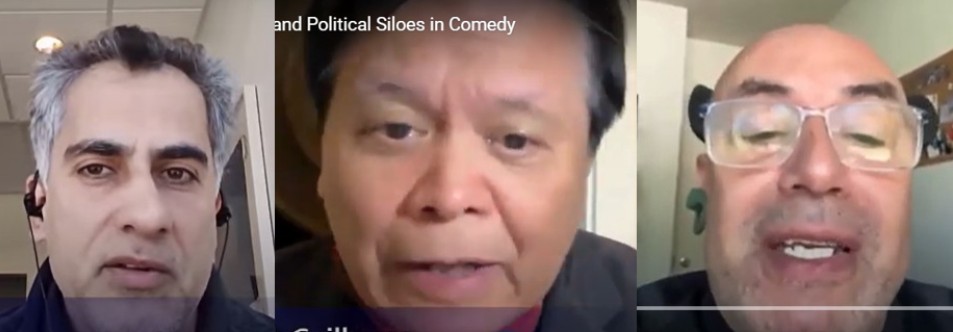
“Humor is always a part of our culture,” said Herbert Siguenza, founding member of the performance troupe Culture Clash. Speaking during an ACoM virtual briefing, Siguenza noted he was heading to a funeral that day. “Although it’s sad, there’ll always be somebody who comes up to the altar, right, and says something funny…and everyone needs that as a release.”
Siguenza, whose group was formed in San Francisco and has performed satirical sketches and plays in English and Spanish since 1984, described the comedian’s social role as that of an outsider: “We can make fun of the right and left. We’re just commenting on the ridiculousness of everything… You’re outside societal morality and norms just a little bit.”
Death camp jokes
Topical material sometimes hits too close. When it comes to immigration enforcement, for example, Siguenza said, “It’s like making death camp jokes; they’re just not going to go over…When I see federal officers taking people out of their cars, out of their homes, and they’re separating their kids, it’s like, how do I make a joke about that?”
Siguenza had similar concerns about the current administration signaling pressure on late-night comedy hosts like Jimmy Kimmel and Stephen Colbert: “That’s fascism 101, you shut down the comedians first…The court clown is the first guy to go because he had the liberty for a while to say anything he wanted about the king, and then suddenly he said something wrong.”
In response to a “Late Show” rerun last December in which Colbert teased Trump for hosting the Kennedy Center honors ceremony — which aired the same night CBS broadcast the Kennedy Center Honors ceremony to low ratings — Trump demanded CBS “put him to sleep” and pull the already-canceled show immediately rather than let it run through its planned May 2026 finale.
For five days last September, ABC did suspend “Jimmy Kimmel Live!” following pressure from Trump and his officials over a monologue by Kimmel regarding Trump’s allegedly indifferent reaction to a journalist’s question about the murder of Turning Point USA founder Charlie Kirk.
Humorist and journalist Emil Amok Guillermo noted the irony in how the same company that could cancel Colbert — Paramount, which owns CBS — could continue airing “South Park” episodes involving “Trump, naked, small penis, impregnating Satan.”
Guillermo suggested that satirical ridicule may be more impregnable and more cutting than political commentary dressed up as comedy: “What ‘South Park’ did was just lay out ridicule. And fascist autocrats hate ridicule, which is why the ultimate lesson is: Watch more ‘South Park.’”
“Humor comes out of pain. Humor comes out of tension. When it’s so tense and the pain is so real, that’s the perfect moment for humor. It’s the antidote to all of that,” Guillermo continued, adding that in his own columns he uses “a Mary Poppins theory: ‘A spoonful of sugar helps the medicine go down.’ …That’s the job of the comedian to poke holes at the big bubble that we’re living in, and to try to get at what’s real.”
‘Humor is agreement’
For Samson Koletkar, co-founder of Desi Comedy Fest, the engine of comedy is simpler and more democratic.
“Humor is agreement,” he explained. “If I tell a joke and you laugh, it’s because you agree with me, and if you don’t agree, you don’t laugh. And that agreement is a very instant thing. You can’t plan for it. A lot of people are thinking the things we say out loud, and then the shock and the humor comes from the fact that somebody actually said it out loud.”
Koletkar, who has also run the stand-up club Comedy Oakland for 17 years, pushed back on the idea that comedians have a unique imperative or moral position: “Sometimes they try to put themselves too high up on the horse, like we are the truth speakers. Only as long as people are laughing — when they don’t, you change your truth a little bit as well … Everybody’s on the same playing field.”
Regarding censorship, “Comedians are born out of a rebellious state of mind. If you ever tell a comedian not to say something, that is exactly what they will talk about,” he said. – American Community Media