
Marcos Jr. seeks support for non-permanent UN seat to ‘help calm voices of division’ in the world
By Elton Lugay & Cristina DC Pastor
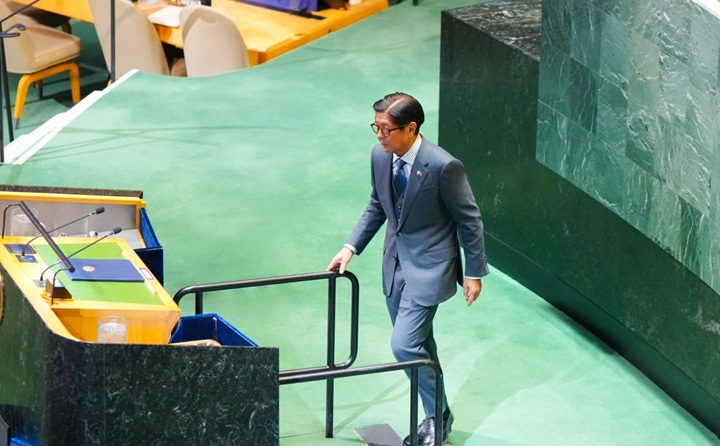
President Ferdinand Marcos Jr. sought United Nations support for the Philippines’s candidacy for a non-permanent seat on the United Nations Security Council (UNSC).
In a speech at the United Nations Headquarters, he urged member states to back the Philippines’s latest bid for a Security Council seat for 2027-2028, amid rousing applause from about 200 community leaders in attendance.
“Our contributions across the whole spectrum of UN work, since its inception, are borne out by history. Always ready to be part of the solution, the Philippines has regularly proven itself to be an independent, trusted partner, an innovative pathfinder, and a committed peacemaker,” Marcos said during a special address to the UN General Assembly in New York City on March 9.
“In the midst of mounting challenges and uncertainties, our United Nations needs steady, committed, experienced hands; and we humbly offer ours – to serve in the UN Security Council for 2027 to 2028,” he added.
The current non-permanent members of the UNSC are: Bahrain, Colombia, Democratic Republic of the Congo, Denmark, Greece, Latvia, Liberia, Pakistan, Panama, Somalia. They were elected on June 3, 2025 and slated to serve for two years.
They join the five permanent members — China, France, Russian Federation, the United Kingdom, and the United States – as they deliberate important global issues.
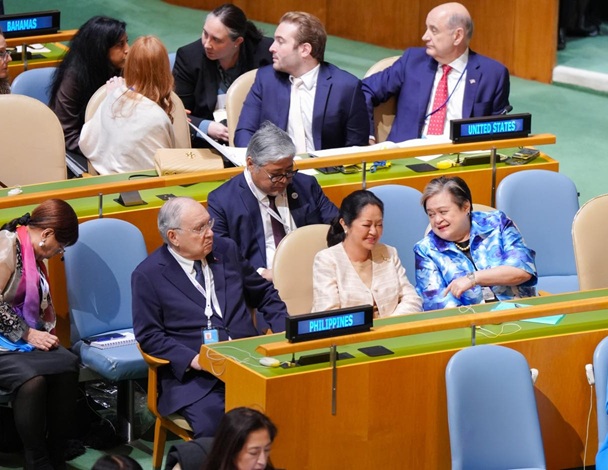
Enrique A. Manalo (seated second row)
“The Philippines stands ready once again to contribute, to help calm voices of division, provide a voice of balance, to shun ambition for service, and always as a voice for principled peace,” Marcos said. “And thus, I stand before you to humbly petition for your support for the Philippines in the elections on the 3rd of June, 2026.”
Former Consul General in New York Mario de Leon welcomed Marcos’s “strong reaffirmation” that multilateralism and respect for international law “remain essential to preserving peace” amid rising geopolitical tensions.
De Leon said the Philippines’s record of consensus‑building, peacekeeping and adherence to international norms shows why the country is a “credible and principled candidate” to serve again as a non‑permanent member of the Security Council.
“The Philippines was previously elected as a non-permanent member of the UNSC in 1957, 1963, 1980-1981, and 2004-2005,” as reported by the State-owned Philippine News Agency.
It was “actively engaged” in UN peacekeeping since 1963, deploying nearly 15,000 Filipino peacekeepers to 21 peacekeeping operations and special political missions, it added.
De Leon said the country’s voice would help “advance diplomacy, stability and cooperation” in an increasingly complex global environment.
Loida Nicolas Lewis, chair of the Coalition for Filipino Amerasians, said Marcos’s speech covered the Philippines’s history with the UN “from being a co‑founder in 1946 up to the present, the failure of diplomacy to avoid war in various parts of the world and the Philippines’s stand for the rule of law.”
She said the speech reminded her how “deeply embedded” the country has been in the UN system’s evolution.
Foreign Affairs Secretary Ma. Theresa Lazaro told Inquirer she viewed the president’s presentation as “a comprehensive reminder” of Manila’s contributions to UN peacekeeping, migrant protection, and women’s empowerment.