
‘How Can You Forget Me:’ A moving tribute to the ‘manongs’ at the Smithsonian
By Loida Nicolas Lewis
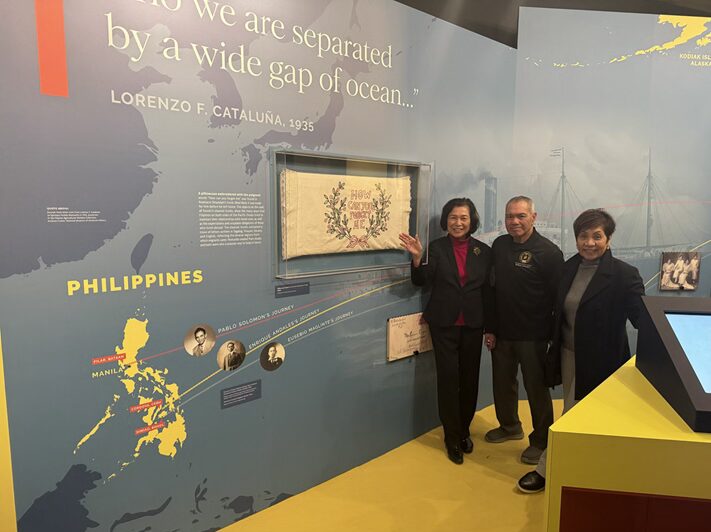
WASHINGTON, D.C. — The newly opened exhibition by the Smithsonian Asian Pacific American Center (APAC) and on view at the Smithsonian’s National Museum of American History entitled “How Can You Forget Me: Filipino American Stories”, is a must-see for Filipinos in the Diaspora, especially Filipinos in the United States. Opened in December 2025, we have up to November 28, 2027 to pay our respects to our predecessors.
A group of us, hosted by Rick H. Lee, APAC’s director of External Relations and Strategic Partnerships, visited the exhibition and had a glimpse of the life of Filipino migrants who came to California in the early 1900s.
The background of the exhibition is this. In 2005, when Antonio Somera was looking for space to open a martial arts studio in the basement of the Legionarios del Trabajo building, known as the Daguhoy Lodge, he discovered 26 large steamer trunks owned by Filipinos who found jobs as farm workers in the 1910s and 1920s.
The exhibition features three of those trunks and presents a time capsule of the “manongs”, the term used for the mostly men from the Ilocos Region of the Philippines, initially recruited by American companies to work in their huge farm lands.
Why from the Ilocos Region?
Because the Philippines was annexed as a colony by the United States from Spain by the Treaty of Paris ending the Spanish American War after the famed Spanish Armada was defeated by Admiral George Dewey in Manila Bay in 1898. The American recruiters discovered that the Ilocos Region was hot and arid, just like the farms in California and Hawai’i.
As described in the Smithsonian’s exhibitions page, the recovered trunks and their objects offer “a window into what was once the largest population of Filipinos living outside of the Philippines. These mostly male migrants settled and established a vibrant community in south Stockton, California, which became a crucial hub for Filipinos arriving in the United States. There, in what came to be known as ‘Little Manila,’ they thrived—forming families, labor unions, and mutual aid societies.”
“Featuring over 50 artifacts from the trunks, along with objects loaned from the Filipino American community in Stockton, this exhibition helps us remember the people whose labor contributed to the growth of California’s agricultural industry and paved the way for future generations of Filipino immigrants.”
This time at the National Museum of American History, a slice of life of Filipinos working in the fields to harvest asparagus, strawberries, pineapples, grapes etc. are in full display zeroing on the contents of these well-preserved trunks.
The photos of three young Filipinos—Enrique Andales, Eusebio Maglinte, and Anastacio Omandam—show them in suits and regalia, looking like the Hollywood actors in the early 1920s and ‘30s.
The photo of a Filipino woman dressed in a white sequenced gown shows that in that part of California, the Filipino custom of beauty contests or town fiesta with beauty queens was very much alive.
The contributions of labor leader Larry Itliong are also highlighted in the exhibition, showing that he led the Delano Grape Strike of the 1960s and formed a coalition with Mexican labor leader César Chávez. Their joint efforts brought about better wages and working conditions for farm workers.
Although the exhibition presents the successful image of the three “manongs”, most trunk owners probably remained single most of their lives due to the low numbers of early Filipina migrants and the anti-miscegenation laws restricting interracial marriages.
I am reminded of Carlos Bulosan’s classic semi-autobiographical “America Is in the Heart”. He depicted stories of the “manongs” who toiled in brutal conditions and faced bigotry, discrimination and prejudice in the farms of California and Hawai’i, as well as in the fisheries of Alaska.
In fact, one of his short stories became an award- winning drama staged by Ma-Yi Theater. Set in California’s Central Valley in the 1930s, “The Romance of Magno Rubio” follows its titular character, Magno Rubio, a four-foot-six-inch-tall, illiterate Filipino migrant worker who falls in love with a white woman from Arkansas named Clarabelle through a “lonely hearts” magazine. While his fellow workers recognize that Clarabelle is scamming Magno for money and gifts, they do not have the heart to tell him, allowing him to hold onto his “American Dream”.
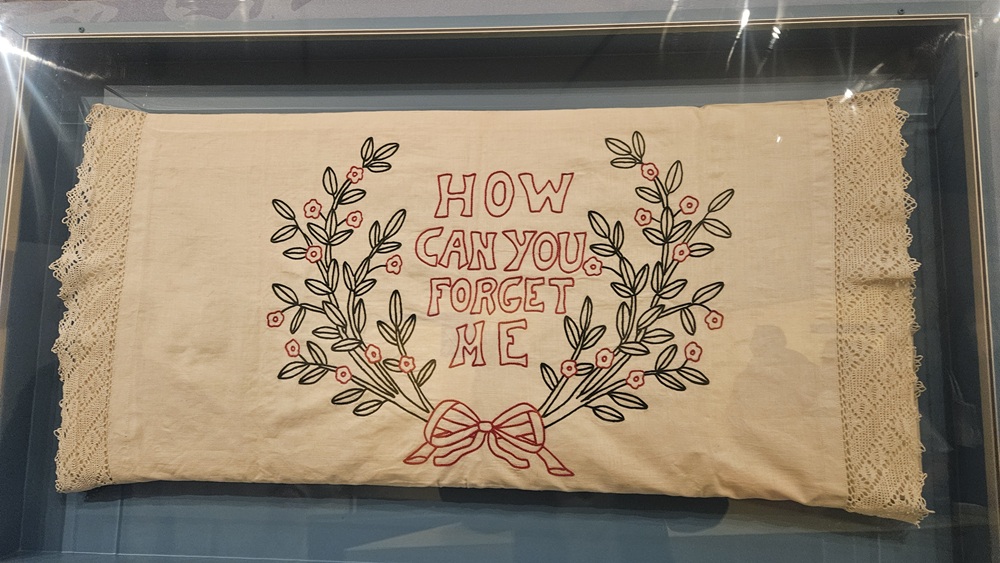
The exhibition title “How Can You Forget Me” comes from a beautifully hand embroidered pillowcase found in Omandam’s steamer trunk. Although the origin of the pillowcase is unclear, a visitor may imagine that Omandam’s sweetheart sent it to him, waiting for her boyfriend Omandam to come back and claim her as his bride.
These are some of the highlights and heartbreaks of the exhibition, “How Can You Forget Me: Filipino American Stories,” in Washington D.C. now on display.