
When cultural, generational identities clash in a Filipino kitchen
By Allen Gaborro
There are few things in this world that Filipinos cherish more than food, family, drama, and their cultural heritage. So, when you combine all these disparate elements into a passionate, multifaceted chiaroscuro of a very personal work of fiction, you can’t help but feel the anticipation of experiencing what it means to be a Filipino.
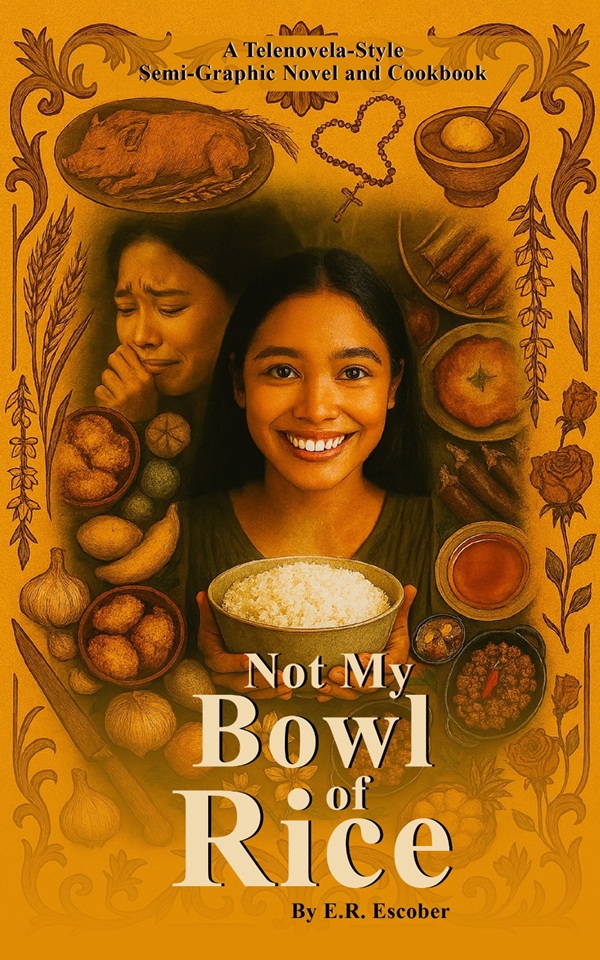
Such an experience is to be found in E.R. Escober’s 2025 book “Not My Bowl of Rice”. The novel is a restoration and a creative reenvisioning of his 2002 story of the same title. As Escober eclectically describes it, his newest version is “A Telenovela-Style Semi-Graphic Novel and Cookbook.”
The mother-daughter dynamic can be an extraordinary collection of tensions involving generational divides, arduous expectations, and even parent-child rivalry. In “Not My Bowl of Rice,” the daughter, the 25-year-old Ligaya De Guzman, finds herself at odds with her tradition-centric mother.
Ligaya, desperate to bring about a harmonized cultural self-awareness as a Filipino American, lives a life that “had become nothing but an endless telenovela of pain and betrayal!” Her autonomous, dissenting outlook engages in a clash of wills with her matriarch of a mother in the kitchen, “that fragrant battlefield of spices and simmering anxieties.”
Escober’s literary stewardship guides us along a path rich in cultural symbolism, explored through home-cooked Filipino-style recipes. He transports his readers into the vibrant, irresistible world of “Filipinoness.”

Escober meets what is a moment of contrapuntal socio-cultural discourse in which the once-dominant colonial narrative of power and definition has given respect to the once-suppressed indigenous perspective. In riding an irregular storytelling rhythm, Escober hits sweet and savory spot after spot in speaking to both the Filipino and American ethoses.
“Not My Bowl’s” theme of being a Filipino in America strikes a sensitive chord with the author. Escober is a Filipino American so he has a first-hand understanding of how Filipinos are affected by both the dream ideal and the challenging reality presented by the United States.
America can be a Garden of Eden. On the other hand, it can also be a larger-than-life, inescapable burden. Almost as a rule, every one of its residents, natural- or foreign-born, must negotiate between those two demanding poles. A goal of Escober’s work is to help the Filipino American self-achieve and maintain a balance between these two poles.
In “Not My Bowl of Rice,” there is a palpable, ongoing search for belonging—specifically to a fixed center that acts as a sacred space. As seen in Escober’s novel, the Filipino institutions of culture, values, family, and cuisine converge within that sacred space to forge a complex yet authentic identity.
Escober’s creative mind wanders off on its own, away from conventional frameworks and methodology. As any red-blooded Filipino would approve, Escober sets great store in making Filipino food one of the novel’s centers of gravity. An explosion of gastronomic delights permeates “Not My Bowl”. They come together not simply to heighten the culinary senses but also to welcome us into the epicurean depository that houses wellsprings of memories, cultural identities, and cultural inheritance.
The evolution that “Not My Bowl of Rice” has undergone over the last 20 years since its original release has resulted in eye-catching changes. Escober’s boldness and daring shine through as he takes us in a different direction—from his 2002 publication—in terms of literary genus, form and content, prose style, and vivid conception.
From the vantage point of Filipinos and Filipino Americans, “Not My Bowl of Rice” projects a healthy amour-propre. It informs them where they have been and where they stand now as a collective of culturally kindred spirits. Filipino culture and heritage are a rite of passage that E.R. Escober makes sure that his kababayan and general reader alike embrace to the fullest.
