
Filmmaker Desireena Almoradie on queer parenting and the joy of letting a child become himself
By Cristina DC Pastor
“He has very deep emotions,” says mom Desireena Almoradie. “Today he was upset because his best friend was getting close to another friend. There were some tears. He handles complex emotions very well; he just doesn’t always have the words for them yet. It’s very interesting to see.”
Desireena was describing how her 6 year-old son Cillian is discovering the complexities of friendship and emotions. He was upset, maybe slightly jealous, that his friend is starting to find new friends, but at the same time was tough enough to handle the likelihood he could lose him entirely.
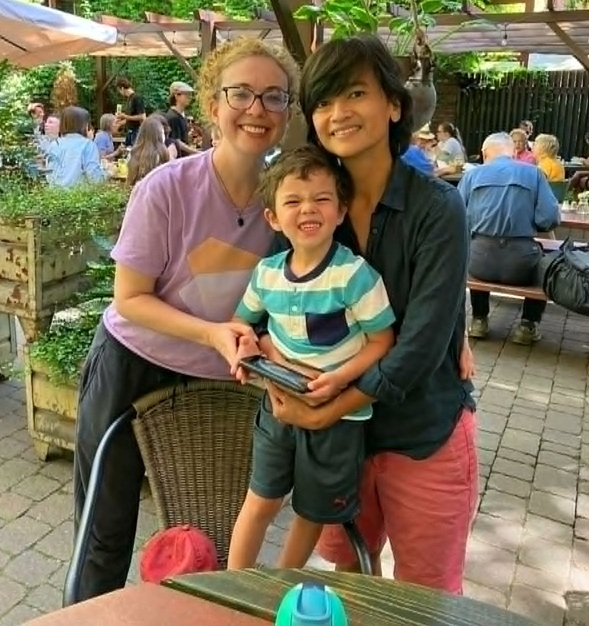
For acclaimed Filipino American filmmaker Desireena Almoradie, raising a child in a same-sex household is less about preparing the child for rejection and more about nurturing a good heart.
That simple wish guides the life she and her Irish partner Niamh, a French teacher, have built in Washington Heights, New York City, where they are raising an energetic, curious boy who loves talking, drawing comics, writing stories, and watching Teenieping cartoons.
For Almoradie, parenthood began with a decision that many prospective parents know well: realizing there is never a perfect time.
“You are never really ready to have a child,” she says. “It is a now-or-never decision.”
She recalls a walk through Central Park with Niamh when they confronted the question directly. “She asked me if we were going to do this or not. I told her we are never going to be ready, so we should just do it.”

Almoradie acknowledges that queer parents often face concerns about acceptance, both from society and sometimes from relatives. Yet her experience has largely been one of support.
“My family is a typical Filipino family,” she says with a smile. “They don’t say anything negative about me or my partner or Cillian. They may have thoughts, but they don’t say it because they don’t want to offend anybody.” More importantly, she says, her immediate family has embraced them fully.
The journey to becoming parents was neither simple nor guaranteed. Like many couples pursuing assisted reproduction, they faced uncertainty and repeated attempts before success.
“With insemination, you have to go through a few rounds before you become pregnant,” she explains. “We went through three or four rounds before finally getting pregnant with Cillian, and we got lucky.”
Even with insurance coverage for IVF and the advantage of being a two-income household, the financial realities of raising a child in New York were daunting.
“When I was calculating daycare when he was young, it was like paying for another apartment,” she says.
As Cillian grew older, the couple encountered questions unique to donor-conceived families. Around age two or three, he began asking where his father was.
Rather than avoiding the conversation, Almoradie and Niamh turned to children’s literature for guidance. They found a book written by an author affiliated with a nonprofit sperm bank that explained donor conception in language children could understand.
“The book explained that sometimes families don’t have the sperm needed to make a baby with the egg,” she says. “So they find nice people who donate their sperm to help these families, and that’s how you became part of our family.”
They read the story to Cillian repeatedly. Over time, the explanation became part of his understanding of how families are formed.
“Now he barely asks that question,” she says. “My sisters and my close family love Cillian. They are nice to my partner and me, and we are lucky to have their love and support.”
Though born and raised in New York, Cillian carries traces of his Filipino heritage. He knows a handful of Filipino words, including the humorous favorites “laway” and “kili-kili.”
Living in New York City has also provided a welcoming environment. In their neighborhood, queer parents support one another, share advice, and help create a sense of community.
“We never really experienced hate or negativity from anybody in our community as two queer women parenting a child,” she says.
While some people assume that same-sex parents must fit traditional maternal and paternal roles, Almoradie rejects that notion.
“In queer couples where there are two women, people often challenge each other about who is the maternal one,” she says. “Sometimes the answer is simply that you have two moms.”
Parenting, she notes, is about shared responsibility, communication, and love. Her goal for Cillian is to be good and happy. “I do not care if he is a plumber or an astrophysicist as long as he’s happy.”
Almoradie brings the same thoughtfulness to her family life that she does to her creative work. An Emmy-nominated filmmaker and GLAAD Media Award winner, she has spent her career documenting queer and BIPOC histories and experiences. Her latest documentary, Because of You: A History of Kilawin Kolektibo, created with Barbara Malaran, continues that mission and is currently making the festival circuit.
This interview aired this week on Makilala TV, mnn.org.