
ON GLOBAL FILIPINOS Dado Banatao: Modern Filipino hero

By Loida Nicolas Lewis
On Christmas Day, 2025 the Philippines lost our modern Filipino hero. Diosdado “Dado” Banatao died peacefully in the presence of his family in his Alma Mater Stanford due to a neurological condition at 79 years old, five months before his 80th birthday.
But what a life of eight decades!
Dado was born in a small barrio of Iguig, Cagayan in northern Philippines on May 23, 1946. His father, Salvador Banatao, a rice farmer, and his mother, Rosita Pamittan, a homemaker, encouraged him to work hard in school, education being the only key for his son to get out of poverty. Dado walked six miles to school barefoot; his parents could not afford to buy him a pair of shoes.
While most of his classmates stopped at 6th grade to help their fathers in farm work, he was determined to finish his schooling because he had dreams to become an engineer.
A teacher saw his potential and recommended him to the Jesuit high school Ateneo de Tuguegarao as a scholar. So he studied doubly hard while his rich classmates played basketball. The famed Jesuit education “do your best” to be “a man for others” was inculcated in him.
Dado graduated from Mapua University cum laude with degree in Electrical Engineering.

Although he was offered a job at Meralco, then one of the largest corporations in the Philippines, Dado chose to join Philippine Air Lines as a trainee pilot in order to travel the world. He saw an opportunity to work in the U.S. so he joined the airline manufacturer Boeing as a design engineer for the company’s new commercial airliner and cargo transport aircraft, Boeing 747.
With the opportunity to stay in the United States, he then took his Master of Science in Electrical Engineering and Computer Science at Stanford University and finished in 1972.
That was when he met Maria Cariaga, a recent graduate of St Paul’s College in Manila and also a new immigrant.
He was late for their first date so that by the time he finished work, restaurants were closed and all he could offer her was Twinkies and soda from the slot machine and the view of Stanford Valley in his old car with holes in the front passenger seat.
But Maria was impressed by his determination and ambition in life. They got married in 1972.
Then Dado worked for several technological companies, met Steve Jobs and Steve Wozniak in Homebrew Computer Club, and started to design the first 10-Mbit with the first system logic chipset and one of the first (Graphical User Interfaces) GUI accelerator chips for personal computers. He is often cited as the Filipino Steve Jobs.
Starting in 1984, Dado in Mostron began to create computer chips that enhanced computer functionality. In 1985, he co-founded Chips and Technologies (C&T) to develop chipsets compatible with IBM’s personal computers. In 22 months, the company went public.
In 1989, Dado started his third company S3 Graphics to enhance personal computer capabilities with GUI accelerators. By 1996, it was the leader in GUI accelerators and Intel bought the company for $300 million.
In 2000, Dado started Tallwood Venture Capital with his own $300 million investment. Later, he sold one of his companies for $1 billion.
Dado was also part of SiRF, one of the first companies to commercialize the GPS after it had been declassified by the United States government.
The key to his success as entrepreneur and founder, he said, “I go around and still manage the company and tell the engineers, ‘Thank you for working hard, but are you capable of doing this?’ ‘Yes, I think I can.’ ‘What do you mean I think? This answer of ‘I think’ does not work. You better be sure because we have a schedule to meet.’ The percentage of success is very high as a result. As a CEO, tell them you’ll be there with them. That’s what builds the Valley.” (Rappler 12/26/2025)
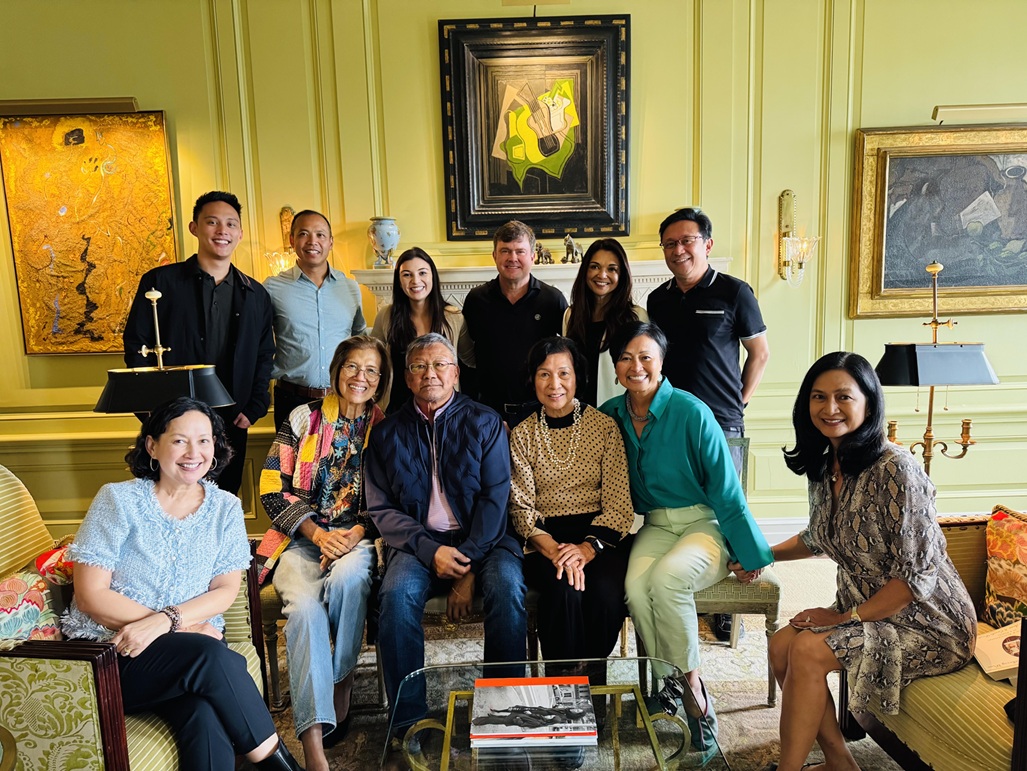
As he became a multimillionaire, he turned his sights to the Philippines because he knew that the million Filipinos on the poverty scale just need the opportunity to quality education, just as he had.
The Dado Banatao Educational Foundation annually awards five educational scholarships to intelligent Filipino students who have bright futures in the field of engineering and technology.
He also built a computer center at his grade school in his hometown of Iguig, making it the only public school with the most modern computer network in the Philippines.
Some 15 years ago, in 2010, he became chair of Philippine Development Foundation which sends brilliant young Filipinos to school to help them reach their full potential. PhilDev was spun off from Ayala Foundation USA founded by Fernando Zobel de Ayala in 2001 to harness U.S. philanthropy towards the Philippines.
Through his Banatao Filipino American Fund, he assists Californian high school students of Filipino heritage who are pursuing a college education in engineering.
The Philippine government recognized Dado Banatao’s world class achievement by having his portrait in the stamp, remembering his words, “We know hardship. It is time we learn success. I am not so special but I am determined. My story could be your story. As Filipinos, it must be our story.”
My dear friend, Dado Banatao, rest in God’s peace. With your inspiring story, with ambition and determination, the Filipino will learn success.
