
Raga weighs possible State Senate bid
By Ricky Rillera
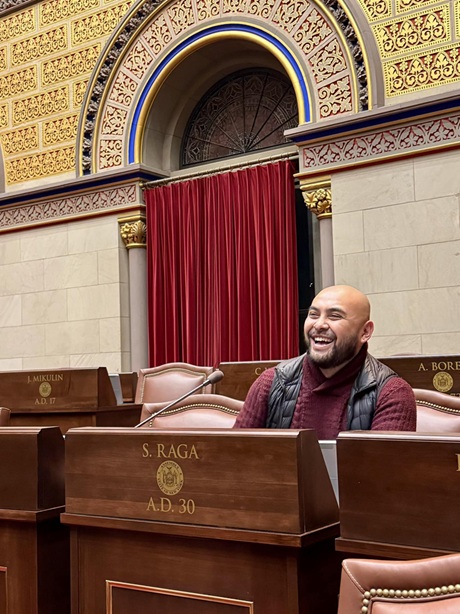
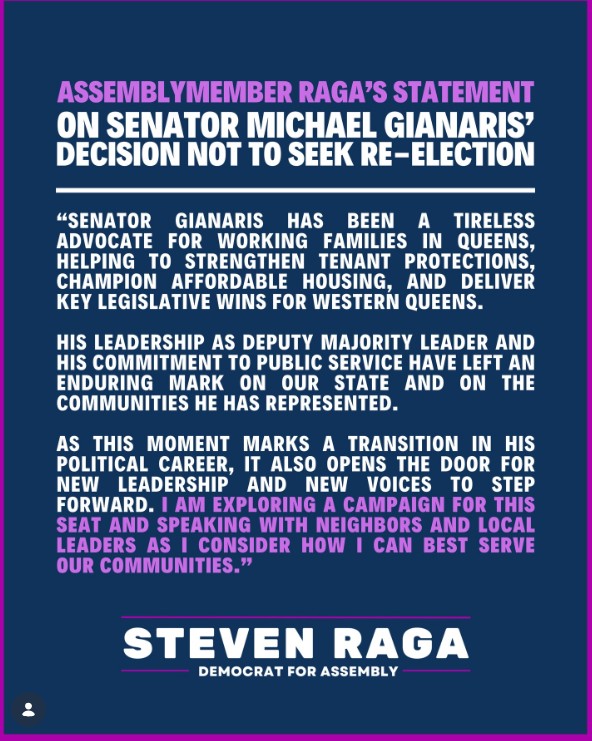
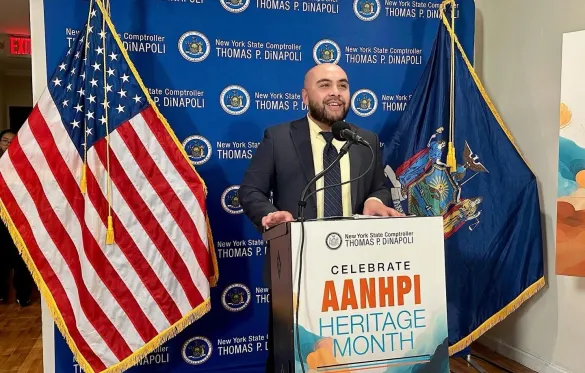
Assemblymember Steven Raga, the first Filipino American elected to the New York State Legislature, is exploring a potential run for the State Senate even as he campaigns for another term in the Assembly, according to a Facebook announcement from his office.
Raga represents District 30 in the State Assembly. Multiple party operatives say he has been approached in recent months by community leaders, labor allies, and Asian American advocacy groups urging him to consider a Senate bid should redistricting create an opening in Queens.
Explorations allowed
For now, Raga remains an active candidate for Assembly reelection. Under New York election law, he is free to explore a Senate run while campaigning for his current seat. The two paths only collide if he formally files petitions for the Senate race, which would legally prevent him from filing for Assembly in the same cycle.
Under New York’s 2026 political calendar, the primary elections for both the State Assembly and the State Senate will take place on June 23, 2026, meaning Raga would have to choose one race well before petitioning begins. The shared primary date raises the stakes of any decision to pivot, since a formal Senate filing would immediately eliminate his path to Assembly reelection and reshape the dynamics of the district’s Democratic primary.
Still, the possibility of a Senate run has already begun to ripple through his Assembly race. Donors, unions, and community groups are watching closely, with some waiting for clarity before committing resources.
A declared challenger, Nepali American community leader Somnath Ghimire, has already entered the Democratic primary. Political observers say even quiet speculation about Raga’s future could influence how the Assembly contest unfolds.
Staying focused
Raga has kept his public comments measured, emphasizing his legislative work in Albany, including bills on language access, healthcare equity, and protections for immigrant workers. Individuals close to him say he has not ruled out a Senate campaign but is cautious about fueling speculation while he remains focused on his current reelection effort.
Community leaders, particularly within the Filipino American and broader Asian American communities, have been more vocal. Many see a potential Senate run as another milestone for representation in a borough where Asian Americans are among the fastest‑growing voting blocs.
“Seeing someone like Steven in the Legislature has already inspired so many young people,” said a Queens civic organizer who has worked with Raga on community safety initiatives. The organizer’s comments reflect a broader sentiment among AAPI groups who view Raga’s rise as part of a generational shift in Queens politics.
A Queens Democratic strategist, who requested anonymity to speak candidly, added that “Raga has proven himself to be an effective advocate for working families,” noting that a Senate run would “reshape the Assembly race overnight.”
Redistricting could open new paths
Any Senate bid would depend heavily on how district lines shift in the next round of redistricting. Several Queens Senate districts — including those represented by Sens. Jessica Ramos, John Liu, Michael Gianaris, and Toby Ann Stavisky — are expected to undergo adjustments. Depending on how the maps move, new opportunities could emerge, or existing paths could narrow.
Labor unions, which have been key allies for Raga, could also play a decisive role. Leaders contacted by the Philippine Daily Mirror said it is “too early” to discuss endorsements but acknowledged that Raga has built significant goodwill through his consistent presence at workers’ actions and wage‑protection campaigns.
Redistricting is happening because court-ordered revisions require New York to redraw State Senate maps. Queens’ rapid population growth, particularly among AAPI communities, is driving significant adjustments. Maps must comply with population balance and Voting Rights Act protections.
Districts to watch:
- SD‑13 (Ramos): Jackson Heights, Elmhurst, Corona
- SD‑16 (Liu): Flushing, Bayside, Fresh Meadows
- SD‑12 (Gianaris): Astoria, Long Island City
- SD‑11 (Stavisky): Northeast Queens
Why it matters for Raga
Depending on how lines move, Raga could find himself in a newly competitive Senate district, in an open seat, if an incumbent retires, or in a district with stronger AAPI voter concentration.
The key factors to watch are population balancing, AAPI voting bloc consolidations, incumbent protection, and possible legal challenges.
For now, Raga continues a full public schedule, appearing at Lunar New Year events, community board meetings, and district forums.
If he enters the State Senate race, Raga will join a growing list of younger lawmakers testing their viability for higher office as New York politics undergoes generational change. Until then, allies say, he is listening — but not yet committing. – Philippine Daily Mirror
