
Staten Island’s Fr. Rhey Garcia’s path to the priesthood: Falling in love with God ‘little by little’
By Cristina DC Pastor
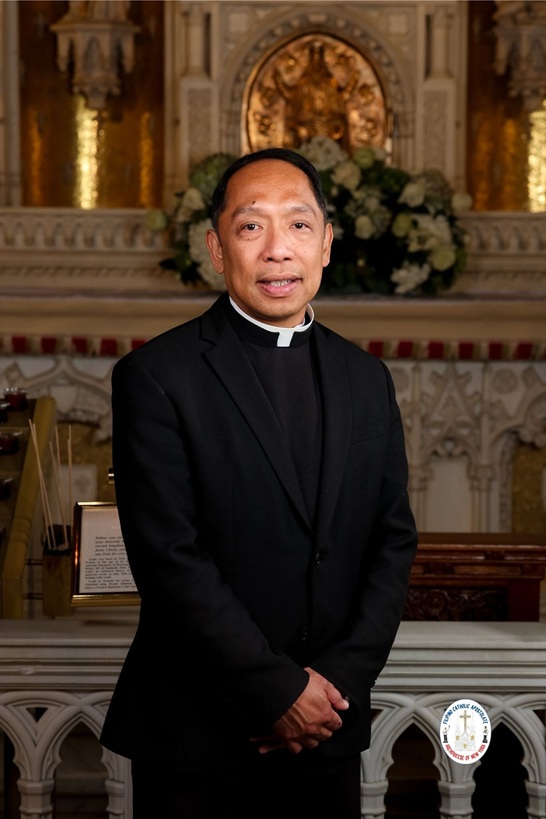
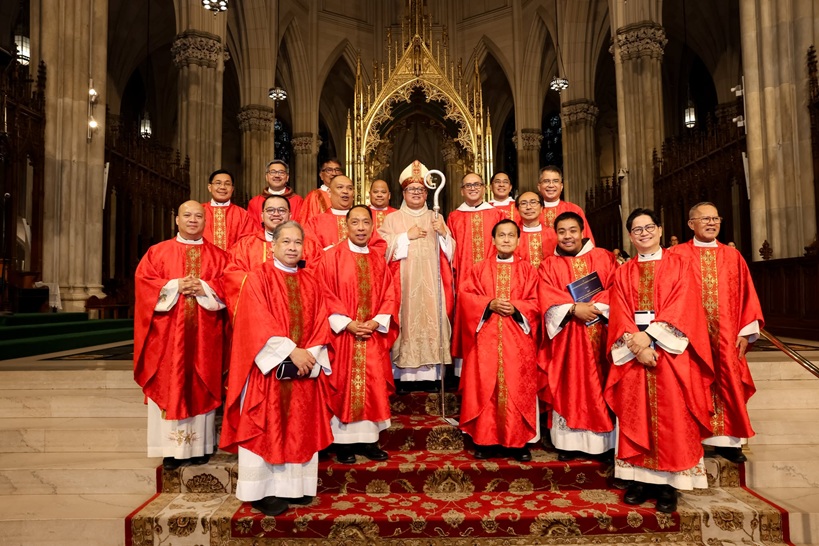
When more than 2,000 Filipino Catholics gathered at St. Patrick’s Cathedral for the first-ever Santacruzan in New York despite heavy rainfall, Father Rizalino ‘Rhey’ Garcia saw something far more significant than a historic event: He saw a community united by faith.
“More than 2,000 people gathered at St. Patrick’s Cathedral despite the torrential rain,” he recalled. “That alone speaks volumes about the deep faith of the Filipino people. They did not come simply for an event. They came to pray, to celebrate their faith, and to honor a beautiful tradition that has been passed on from generation to generation.”
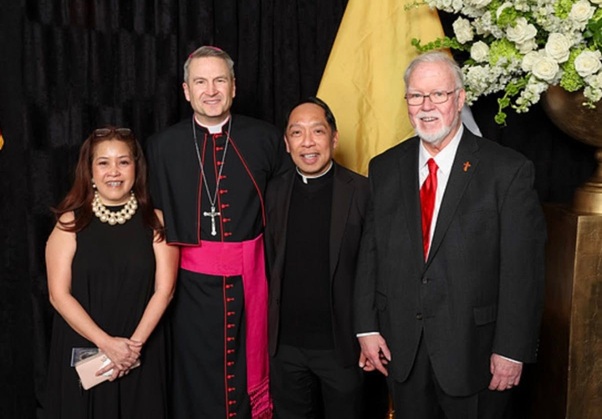
For Fr. Rhey, 55, the historic celebration represented a mission entrusted to him as the first chaplain of the Filipino Catholic Apostolate (FILCA) of the Archdiocese of New York: bringing Filipino Catholics together while strengthening their place within the local Church.
That inaugural Santacruzan marked a milestone for Filipino Catholics in New York. Although the event experienced some logistical challenges, Fr. Rhey did not shy away from responsibility.
“I sincerely apologize to those who were affected,” he said. “As the chaplain, I take responsibility for that. Every first major event teaches us valuable lessons.”
Yet what remained with him was not the confusion but what he called “the communion.”
“What I choose to remember most is not the confusion, but the communion. Seeing thousands of people gathered in prayer reminded me of the words of Jesus: ‘Where two or three are gathered in my name, there am I in the midst of them.'”
Why FILCA was created
FILCA—the Filipino Catholic Apostolate of the Archdiocese of New York—was established to provide pastoral care for one of the Archdiocese’s largest and most active immigrant communities.
“The Church is like a mother who cares for all her children,” Fr. Rhey explained. “By establishing FILCA and appointing a chaplain, the Archdiocese recognizes the vibrant faith of the Filipino Catholic community and desires to care for its spiritual and pastoral needs in a more intentional way.”
His ministry stretches far beyond Manhattan. Filipino Catholics are scattered across the Bronx, Staten Island, Westchester and the upstate counties of Rockland, Orange, Dutchess, Putnam, Ulster and Sullivan. Rather than waiting for parishioners to come to him, Fr. Rhey embraces the pastoral vision championed by the late Pope Francis.
“I am always inspired by the words of Pope Francis, who encouraged pastors to ‘have the smell of the sheep,'” he said. “That means being close to the people, not waiting for them to come to us, but going out to meet them.”
His mission, he said, is simply to accompany Filipino Catholics in their journey of faith through the sacraments, encouragement and presence.
Fr. Rhey said he never sought the appointment as FILCA’s founding chaplain. “I simply received the appointment with gratitude and humility.”
He viewed the role as a call to service. “As Jesus reminds us, ‘Whoever wishes to be great among you shall be your servant.'”
The position has no fixed term, he said. He will continue serving as long as the Archbishop entrusts him with the ministry.
A quiet calling
Unlike stories marked by dramatic conversion experiences, Fr. Rhey describes his vocation as one that grew naturally. His journey began in Alaminos City, Pangasinan, home of the famous Hundred Islands.
“As a child, I regularly went to church with my cousins,” he said. “Those simple moments nurtured my love for God and for the Church.”
Looking back, he now believes those ordinary experiences quietly prepared him for the priesthood.
“I often tell young people that vocation is not just about hearing God’s voice. It is about falling in love with Him little by little.”
He adds that priesthood remains a daily response to God’s invitation. “God does not call us because we are perfect. He calls us because we are willing to let Him shape us.”
Although he now ministers in New York, Fr. Rhey still treasures memories of his hometown.
He recalls climbing the old lighthouse overlooking the Hundred Islands with his cousins and marveling at the scenery below. Whenever he returns to the Philippines, one place is always on his itinerary: the public market.
“I love markets not only in Alaminos but wherever I travel,” he said. “They reflect the life of a community.”
To him, bustling markets represent the dignity of hardworking people and the beauty of simple communal life.
Shepherding the Sacred Heart parish
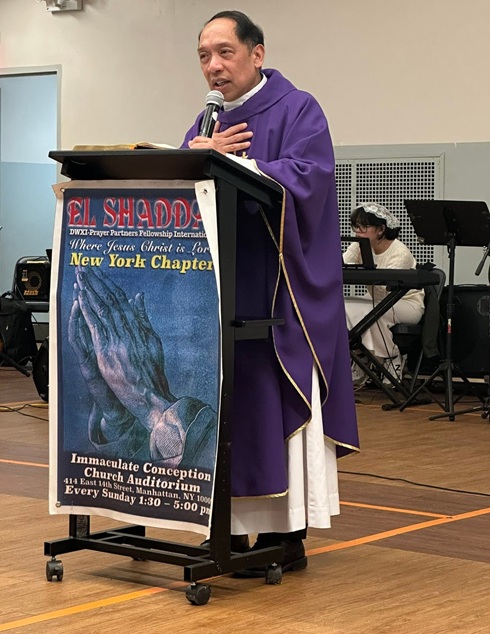
For the past four years Fr. Rhey, the first Filipino pastor in Staten Island, has served as the 11th pastor of Church of the Sacred Heart. The parish celebrated its 150th anniversary in 2025 with Cardinal Timothy Dolan presiding over a standing-room-only mass. In preparation, parishioners launched a campaign to replace the church’s century-old roof and restore its interior.
“Thanks to the extraordinary generosity of our parishioners, we reached our fundraising goal in just three months,” Fr. Rhey said.
He credits the parish’s success to the generosity of its people, including its active Filipino-American members. “They bring their strong faith, love for family, joyful spirit, and willingness to serve.”
Asked how he would compare Staten Island’s FilAm community with Manhattan’s or Queens’, Garcia declined to frame ministry through geography. “As a priest, I don’t look at the community through the lens of geography. I look at people.”
Instead, he emphasizes unity and collaboration among civic organizations, community leaders and parishes throughout New York.
Speaking to a new generation
Fr. Rhey is optimistic about the faith of younger Filipino Americans. “In recent years, we’ve seen many young people rediscovering their faith,” he said.
He remembers one young adult telling him, “We’re tired of fake stuff.” For Fr. Rhey, that statement reflects a generation searching for authenticity, meaning and belonging.
“The Church is not perfect because it is made up of imperfect people,” he said. “But what we offer is authentic. We offer Jesus Christ.”
Faith, he believes, also helps younger Filipino Americans preserve their cultural identity while discovering their deeper identity as children of God.
He believes faith has always been woven into Filipino life. He points to the familiar phrase Bahala na, often misunderstood as passive resignation.
“For many Filipinos, it expresses something much deeper: trust in God’s providence,” he explained. “It means that after doing our very best, we entrust everything to the Lord.”
In a fast-moving world marked by anxiety and uncertainty, he said faith offers stability. “It teaches us gratitude in times of blessing, hope in times of difficulty, and compassion for one another.”
For him, what remains at the center of his ministry is the realization that Filipino Catholics, wherever they may be in New York, find both a spiritual home and a deeper relationship with God.