
Author Cinelle Barnes finds her way back after losing memory from aneurysm

By Allen Gaborro
Today’s volatile, information-laden, post-truth paradigm makes it difficult to turn our focus away from the external world and toward our inward life.
However, even at the risk of confronting doubt, anxiety, and the fear of inadequacy—and with the outside world ceaselessly closing in—we are compelled to observe and comprehend our delicate, complicated interior universe.
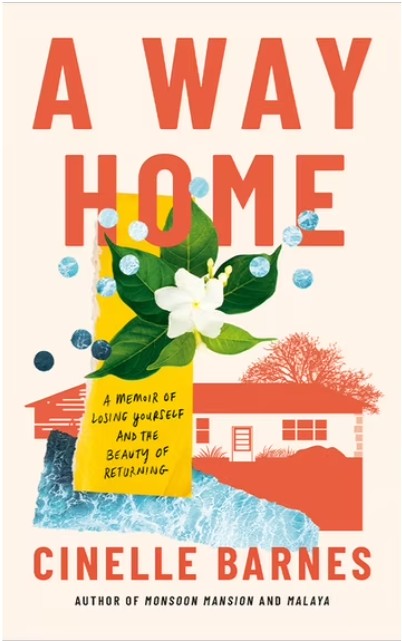
In her book, “A Way Home: A Memoir of Losing Yourself and the Beauty of Returning,” author Cinelle Barnes reveals her most fragile thoughts and emotions. The fact that Barnes composed her life story after suffering a severe neurotrauma gives the book a guilelessly transcendent quality.
In the final reckoning, “A Way Home” is a triumph over incredible adversity—one that exudes a radiant courage and awakened resiliency.
As an immigrant from the Philippines, the turmoil surrounding Barnes’s life would not make it easy for her to feel at home in the United States. It was hard enough coming from a childhood afflicted by family abuse and dispossession and the loss of standing. But because America presented its own daunting challenges—as it does for so many Filipino immigrants—she would find herself leaning on her cultural inheritance.
This is what much of “A Way Home” is about for Barnes: the rekindling of her memory of the past, her lost identity, and her capacity to manage overwhelming obstacles.
In venturing through Barnes’s moving, elegiac yet sanguine combination of an intimate confessional, readers are provided with a great deal of space and inspiration for expressing sympathy and empathy. Barnes, rest-assured, does not render her intense experiences detached from humanity as many others would.
From the prospect of mortality as a result of her aneurysm, the tension caused by her uprooted identity, to undergoing the at times painful, at times purifying, trajectory of revivifying her memories, Barnes can always take comfort in knowing she has a social and emotional support system welling up from the private and public realms.
“A Way Home” is a sobering search for something that is very important to all Filipinos: “Kapwa.” As a cultural cornerstone and core guiding principle of Filipino cultural psychology, Kapwa’s most redeeming quality is its mandate for human solidarity—more specifically, a perspectival tapestry of belonging for Filipinos. In short, an abstractly shared Filipino selfhood.
Barnes’s memoir beautifully taps into the Kapwa she shares with her fellow Filipinos across the homeland and the diaspora. By reaching out spiritually and collectively, she highlights Kapwa as a deterrence to loneliness and as a powerful pull toward perpetual fellowship and equality.
Barnes wants to depict Kapwa not as a hard-and-fast perpetuity, but as a protean, dialectical construct. In her own way, Barnes tries to help foster among Filipinos and non-Filipinos a confluence of real-to-life character, inner transformation out of the past, and a devotional vigilance of the soul and mind, all of which unite to nurture the dynamism of Kapwa.
The title “A Way Home” is fittingly tailored for the subjective story it tells. Barnes’s reimagined idea of what “home” is is inextricably bound with Kapwa. Like Kapwa, Barnes’s understanding of “home” cannot be reduced to a spatial point on a map, a point that never moves. For her, “home” represents a stream of existential becoming as an individual within the force and security of the Kapwa.
On those terms, which are preciously close to Barnes’s heart, both “home” and “kapwa” fortify the ever-symphonic wholeness of all human beings. That atmosphere of indivisibility is fundamentally inseparable from Barnes’s baring of her human frailties, raw authenticities, and reaching a destiny of her own making.