
Bridging the political divide in U.S. immigration through Transformative Journalism Part 4
By Marivir Montebon
This concludes the 4-part dissertation series of Dr. Marivir Montebon which examines the role of Transformative Journalism in immigration reporting.
“We welcome the stranger, yes. But we must have a sound immigration system,” said the head of the church-based legal immigration assistance center who batted for empathy for people migrating to the US in search of supposedly better lives.
This study highlights U.S. immigration needing reform, and recommends the practice of Transformative Journalism, by surfacing real stories from the ground, to bridge political divides.
Volunteers and legal luminaries who are at the heart of providing legal immigration assistance said that they seek media reports that look deeply at the accountability of U.S. Congress on immigration reforms to fix the broken system.
“The INA of 1965 needs to be reformed by Congress to make it responsive to the current times. Executive powers could be politicized and are limited to effect substantial reforms.”
Majority of volunteers in this study pinned their hopes on public clarity and understanding through constant truth-telling, especially coming from immigrants themselves.
“Journalists need to look beyond political posturing and examine both the flaws in the law and the real experiences of immigrants. Current U.S. immigration laws do not align with the country’s needs. Canada, by contrast, regularly updates its immigration policies to reflect changing realities and priorities. In the United States, the focus is largely on enforcement, but the issue is far more complex. The system is so broken that it often causes misinformation. Immigration has become deeply polarizing and politicized. Journalists have the power to bring greater public understanding and cast these issues in a more constructive light.”

“Media reporting can build awareness of the actual immigration process, including the specific steps that need to be undertaken to reach an approved change of status or granted petition leading to adjustment of status, and that will change the narrative and combat misinformation.”
A handful of immigration assistance volunteers in this study did not believe that the current political polarization of U.S. immigration reporting can be done by journalists. It is too idealistic, they contend, because the media is owned by big businesses with ideological and business interests.
How information is processed, filtered
The results of this study provide a picture of how information is processed from the ground — filtered by journalists, editors, and media producers — to create messages that reflect the media’s own ideological frames.
1.Political polarization in the understanding of U.S. immigration begins with interpretation of facts and the constant bombardment of these interpreted messages through mainstream and social media.
2.Information is incubated in the newsrooms, whereby raw information gathered and written by journalists is filtered and interpreted by editors, commentators, and executive producers to suit their specific ideological or political narrative and target audiences.
3.Interpretations of news information contained in commentaries are used and amplified through the commentary sections with four to five more exposure times compared to the one-time exposure of the straight news coverage in a day. The interpretation of news influences public perception and opinion more than the news information itself because of disproportionate exposure times.
4.Journalists admit to the political divide that exists in reporting on immigration issues. Most of the stories on immigration policies and issues are angled narrowly on contending partisan politics, often without including the lived experiences and voices of immigrants themselves.
5.The mainstream media, both liberal and conservative, at varying degrees, have amplified the historical demonization of immigrants due to the lack of historical context and global perspective of immigration.
6. There is a media desert for coverage of real stories but help for immigrants is taking place through church-based immigration assistance centers.
Practicing Transformative Journalism
This study recommends the practice of Transformative Journalism to bridge the political divide in understanding immigration issues. The process involves transforming information into news stories with facts and historical context; enabling journalists to develop empathetic listening skills and self-correction attitude; and ensuring dynamic editorial guidance.
These values respond to the problems identified by this study which are: the lack of historical context in media reporting; the use of demeaning language thus inciting hate; and reporting on immigration issues as just a partisan political issue.
Transformative Journalism is intentional, not only on the part of journalists, but the media organization as well. Thus, its editorial guidance and policy are geared towards the enhancement of Transformative Journalism practices of journalists.
Editors and producers expand the stories of immigration, based on narratives of immigrants, without having to interpret through personal ideologies and incite hate and division in the articles or reports.
Inherent in Transformative Journalism are training for journalists and editors on empathetic listening skills and seminars on immigration visa processes, immigration law history, and immigration policy updates. This requires collaboration with legal and academic, and specialized nonprofit organizations.
With the increasing unfiltered content on social media, outputs of Transformative Journalism have never been more necessary. These are well-researched and contextualized news features and explainer articles for the news consuming public.
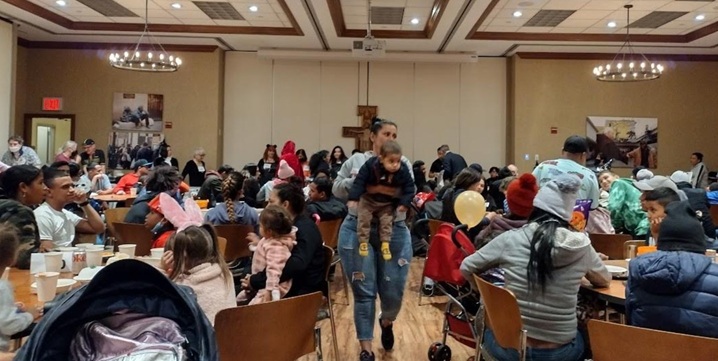
One participant volunteer said it well: “I’d like for the media to report on dignity. The issue is more than just immigration. It’s about people and allowing them to live with dignity. I don’t believe in polarization. When you come to the ground, like at the Migrant Center, we are so much a community here than a division. We all aspire for dignity.”

Marivir R. Montebon is a New York-based journalist who runs her media company Awesome Media, Ltd. In 2012, she established the online magazine OSM! (awesome!) together with her daughter, Leani Alnica Auxilio. In 2022, she started her social media podcast Conversations with MM. She received a Harvard University Certification in August 2025 on “Citizen Politics in America: Public Opinion, Elections, Interest Groups, and the Media.” Montebon was president of the Filipino American Press Club of NY in 2018 and 2019 and now serves as a member of the Board of Directors for 2026 and 2027. In May 2024, she finished her Doctoral Studies, with distinction, at the HJ International Graduate School for Peace and Public Leadership in New York City. She founded Women’s Immigration & Communications Café in 2018, a nonprofit media platform for women and immigration issues.