
Jenny Santi: Art as a path to creating and healing
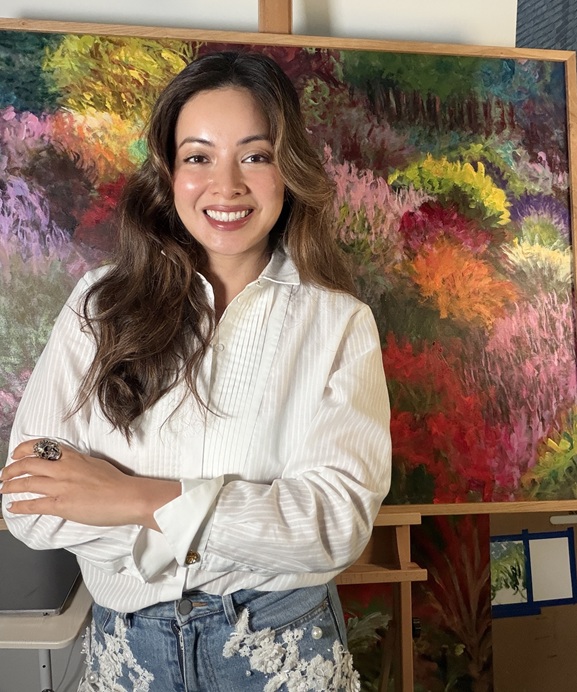
By Marissa Bañez
“I’m a better artist because I’m a therapist, and I’m a better therapist because I’m an artist.”
Jenny Santi’s art is the bridge that connects her two passions, each practice informing the other. Her paintings are both a way of making sense of her own life and an outlet for the emotional residue that inevitably accumulates from the psychological demands of holding space for others as a psychotherapist.
Santi studied classical drawing and painting at the Florence Academy of Art in 2016, developing a foundation in Old Masters techniques before moving increasingly toward abstraction under the guidance of celebrated American abstract painter James Little. She continued her training at the Art Students League of New York, where she has studied for nearly a decade and developed the visual language that characterizes her work today.
It has been a particularly active year for Santi. Her work was presented at the Philippine Center in New York in her first solo exhibition there, “Gardens I Never Knew,” as well as in a group exhibition at the Byrdcliffe Kleinert/James Center for the Arts in Woodstock. Her work has been featured in Artsy and is held in private collections, including that of Lionel Richie.
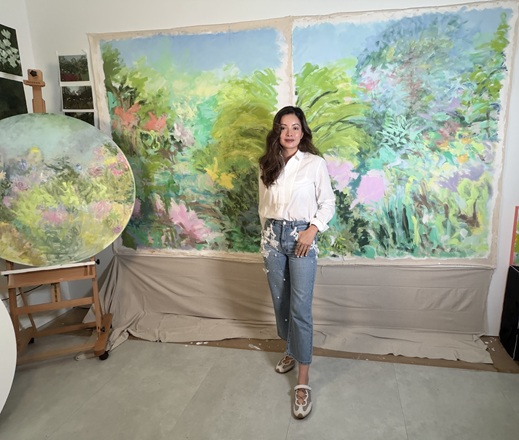
Having lived in the dense urban landscapes of Manila, London, Singapore, and Manhattan, Santi has increasingly turned toward an imagined natural world lush with color and organic form. Growing up, she experienced nature largely in fragments: plants on windowsills, trees along busy roads, flowers brought indoors, flashes of green between buildings.
“My paintings grew partly from a longing for a natural world that often felt temporary and out of reach.”
The flowers and landscapes that emerge in her paintings are therefore rarely observations of particular places. They are invented, remembered, and imagined, closer to emotional landscapes than botanical ones.
In 2025, Santi spent three months as an artist-in-residence at the historic Byrdcliffe Arts Colony in Woodstock, surrounded by a lushness she had previously encountered more often in imagination than in daily life. Living and working within the landscape deepened her fascination with nature, although the flowers, leaves, and tangled forms in her canvases remain largely invented, hovering somewhere between memory and fantasy.
A self-described global citizen, Santi’s recent paintings also reflect a renewed engagement with her Filipino roots, with recurring palm trees and lush tropical scenes. She has begun experimenting with painting on Philippine pineapple silk, or piña, bringing a material connection to the country into the physical construction of the work itself.
Santi is striking in person, with the poise and grace of someone who once worked as a fashion model in her teens and 20s. It is a detail from an earlier life, but one that feels connected to an artist whose work is so unapologetically concerned with beauty and its power to draw us in.
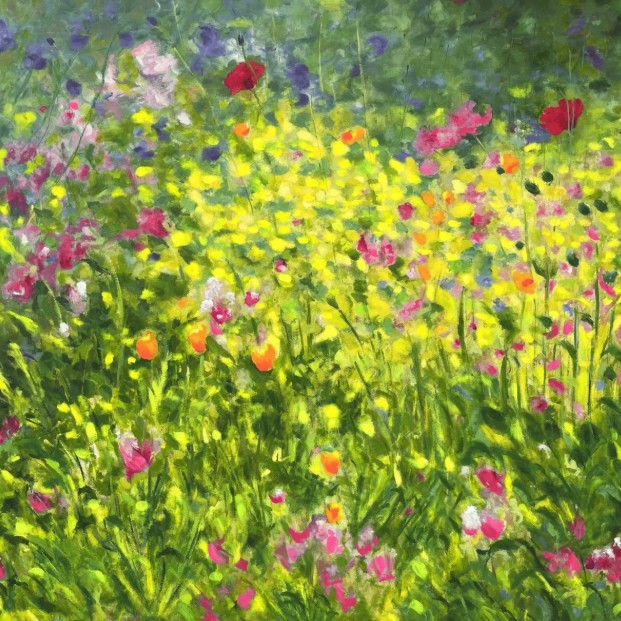
Acrylic on canvas
40×40 inches
Before becoming an artist and therapist, Santi had a very different professional life. At 28, with an MBA from INSEAD that included a semester at Wharton, she became head of UBS’s award-winning philanthropy services in Singapore, advising ultra-high-net-worth individuals and families, including business leaders, celebrities, and royalty on giving, legacy, and purpose. Her earlier career brought appearances and commentaries for TIME, the BBC, Fox News, The New York Times, and others.
Behind that public-facing career, however, were years of intimate conversations with donors about deeply personal questions: what gives life meaning and, ultimately, what makes us happy.
Those conversations became the foundation for “The Giving Way to Happiness,” Santi’s 2014 book published by Penguin Random House exploring generosity and well-being, and eventually helped propel another, more personal reinvention.
Santi realized that the part of her earlier career she found most compelling was not finance or philanthropy itself, but the conversations underneath it: questions about identity, relationships, mortality, purpose, and what constitutes a meaningful life. She went on to earn a master’s degree from NYU in Counseling for Mental Health and Wellness and became a psychotherapist. Today, her clinical work centers largely on high-achieving adults navigating identity, transition, relationships, and meaning.
Because she gives so much of herself as a therapist, the studio has taken on a different function.
“Therapy asks you to sit with an enormous amount of emotion, much of which isn’t yours to resolve. Painting gives me an outlet for all of that. I can go into the studio and unburden that emotional residue into something physical, and hopefully beautiful.”
For Santi, however, the relationship between painting and therapy goes beyond self-care. Both practices require an ability to remain with uncertainty rather than immediately resolve it. In therapy, that means staying present with another person’s experience; in painting, allowing an image to remain unsettled until it reveals where it wants to go.
“I would love to do this for the rest of my life. One of the most unexpected gifts of becoming an artist is how it has allowed me to enjoy my own company. Every painting becomes this problem I have to solve. But I love being inside that process. I love experimenting, getting it wrong, painting over things, making a mess, and eventually finding my way through.”
“I never run out of ideas,” Santi says. “I only run out of time.”
To view Santi’s paintings, visit @jennysantiartist on Instagram or jennysanti.com.
Marissa Bañez is a frequent contributor to The FilAm and several other publications. She’s a lawyer and author of two children’s books, ‘Hope and Fortune’ and ‘Hues and Harmony (How the Rainbow Butterfly Got Her Colors).’
