
Book suggests that the best path forward is to look to the past
Jobert E. Abueva
September 15, 2026
182 pages
By Allen Gaborro
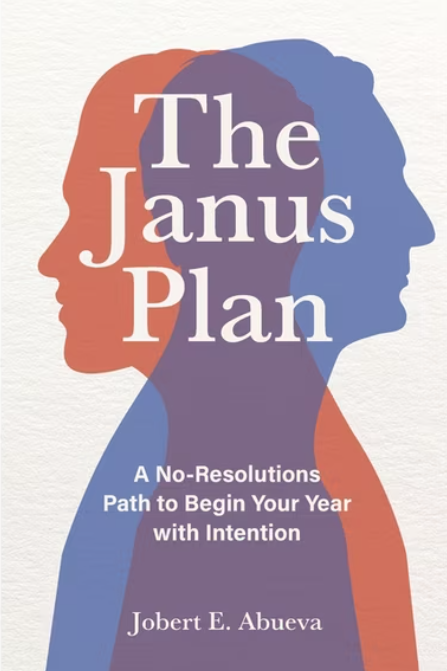
Reverting to the Religio Romana era, the Janus figure has come to symbolize the dawning of a new day, a hopeful changeover to a prime altered state, and as Jobert E. Abueva frames it in Emerson’s words, “A friend is Janus-faced: he looks to the past and the future. He is the child of all my foregoing hours, the prophet of those to come, and the harbinger of a greater friend.”
Not many people nowadays think of Emerson when they contemplate how to improve their lives. Abueva in his textual nerve center of personal development, “The Janus Plan: A No-Resolutions Path to Begin Your Year with Intention,” has—true to the spirit of Emerson’s quote —accepted the challenge of acting as an empathetic guide for—to return to Emerson again—“gods in ruins.”
Emerson was speaking to how the breakneck expectations of modernity blunted the great spiritual endowment and worldly potential of human beings. Abueva, with the greatest care and sincerity, asks his readers to gaze back at the past—not to dwell in it. He wants to use the past as an instructive, existential bedrock off of which they can leap forward into a viable, independent future.
I would describe “The Janus Plan” at least in part as a holistic roadmap that is intended to surpass the law of human averages. It does so with a pragmatic, methodical presentation that is designed to be accessible to anyone and everyone. “The Janus Plan” features a six-stage conceptual model aimed at easing the passage from the gallery of the past to the possibilities of the future.
Abueva works hard to persuade the viewing company he hopes to keep that the best path to success is to recast old ways of doing and thinking in order to capitalize on whatever happens to be their wholesome purities. But he also reminds us not to neglect the past from which we should turn its collection of hardwired casualties into valuable lessons for the future.
Abueva’s scheme is well-thought out and progressively strategic. However, what his plan possesses in initiative and sense of purpose it lacks in originality and creativity. Abueva recommends little that other authors of individual empowerment haven’t advocated over the years. Not that there is anything wrong in bringing back to the surface tried-and-true ideas if in a modified state. But how much of the satiated self-help reading crowd will overlook that underwhelming backdrop?
This then leads me to another source of misgiving about Abueva’s enterprise. In perusing “The Janus Plan” you get the nagging impression that the author is talking more to himself than to the consumers who are willing to give his book their time and energy.
While we can commiserate with Abueva’s battles in overcoming his previous struggles, from a critical standpoint his plan essentially becomes an immovable object with all of its fundamental inclinations. Abueva’s plan is ostensibly malleable and intimately cathartic but it hints at an unwitting self-referentiality. Meaning to say, Abueva comes innocently close to presuming the Janus Plan will work for one and all since he believes it has worked for him.
By and large, Abueva’s heart and mind are in the right place. In his defense, he gets an “A” for effort in offering generative, transparent solutions for what can be complicated private and professional issues. Be that as it may, with deference to that captive audience sorely willing to take a chance on the Janus Plan, I must return to Emerson one last time: Looking outside for answers can be folly. Rely on yourself; all is within.