
Sharon Cuneta finds dramatic depth in ‘Honor Thy Mother’

By Joel David
Amid all the usual prestige vehicles for each and every aspiring Philippine film practitioner angling for some award or other, a pair of teaser episodes has been generating buzz of a different, implausible sort.
The material is modest enough to enable most viewers to predict the moral arc that the story will be observing: a young mother is forced by her entrepreneurial father to devote her best years to maintaining the top industry stature of their soda product. She winds up neglecting her husband and daughter, with the former straying into the arms of her former best friend and the latter, forced by a courtroom to decide, expressing preference for her loving but improvident father.
The series opens with a prominent global burger chain agreeing to exclusively feature Cala Soda in their outlets, but a series of unfortunate incidents culminates in an unmitigated PR disaster: the festive residents of a rural community are felled by food poisoning, and Cala Soda appears to have been the cause. The burger company cancels its planned partnership forthwith, and the stress of attending to several competing demands results in the now-mature career woman, dubbed “the nation’s chairmom,” suffering a stroke that lands her in hospital.
The media frenzy over the incident picks up the story of Diana Aragon’s long-estranged daughter, since her death would raise the issue of inheritance. Amid the internet-era frenzy of strangers swarming the hospital claiming to be Aragon’s daughter, a young woman dressed as an orderly is recognized by Diana’s covetous brother as Patricia, Diana’s offspring.
Diana’s immobilization becomes the opportunity for the rest of the supporting characters to present their backstories, and for people unfamiliar with the state of Pinas telenovela production (as I am, regrettably), the actors for the most part range from striking to excellent, promising future delights when their roles can be further developed.
The directors also exhibit a fluency with the quirks of contemporary TV-drama development and handling, constantly finding ways to take the material to the brink of parody without allowing it to topple over and embarrassing themselves, not to mention their characters. (The series’ directorial tandem comprises Onat Diaz and Dolly Dulu, whose debut project was the last entry in the study I completed, titled Canon Decampment.)
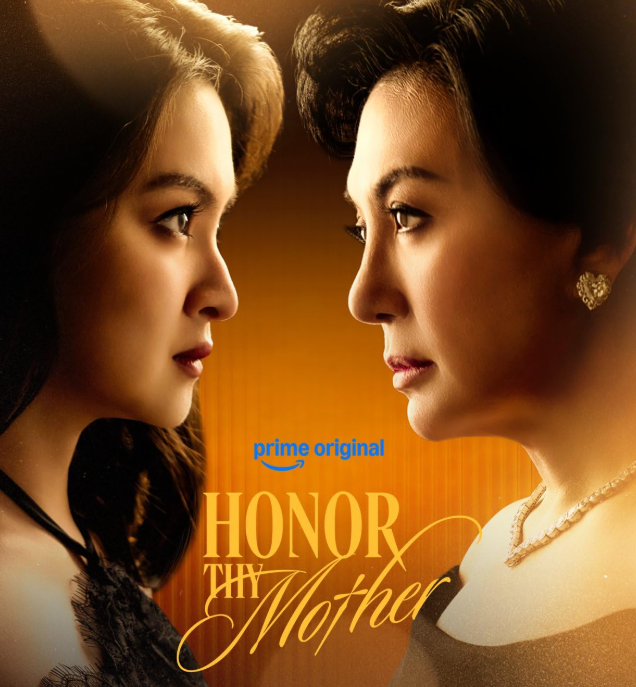
Hence Honor Thy Mother is suffused with a youthful sensibility beyond its casual deployment of digital-media phenomena. But what has aroused excitement even among elderly observers is its unexpected packaging of a throwback to the long-concluded Second Golden Age of Philippine cinema: it allows Pinas pop culture’s final multimedia star, Sharon Cuneta, to take center stage, deactivates her from the middle of the first episode to its close, then finally unleashes her on an audience who might still be wondering whether movie-queen stardom can still be possible in this day and age, especially after the death over a year ago of Nora Aunor.
HTM is not only reminiscent of Balot (2023), the unexpectedly viral softdrink ad where a Cuneta impersonator sang her “Bituing Walang Ningning” lines to commemorate the cultural practice of bringing home excess food from a gathering in order to extend the celebration in other places and with other people. It also references a still-unreleased Aunor film, Adolfo Alix Jr.’s Kontrabida, where the late star paid tribute to her fans and associates by positioning herself as a forever-struggling has-been. (Both Balot and Kontrabida were also reviewed in The FilAm.)
With HTM, one will have to accept that Cuneta exhibits the clear potential to match Aunor’s capability of infusing her roles with camp and humor while still drawing out deep reserves of rage and pain. The role reaches far into her past as performer, to her best collaboration with Lino Brocka, Babangon Ako’t Dudurugin Kita (1989), but with clear evidence of keeping abreast of shifts in media values and expectations. The emotional and analytic intelligence on display is staggering and can hardly be contained by the medium, making her close observers wonder when she’ll be returning to hard-core film performance. Like Aunor, she could even be more than ready for the legitimate stage; all that’s missing is the kind of fire that induced her predecessor to keep seeking ways of pushing her limits in order to afford Philippine appreciators the opportunity to delight in witnessing our finest talents uncovering the fullest extent of their potentials.
Joel David is a retired Professor of Cultural Studies at Inha University and was given the Art Nurturing Prize at the 2016 FACINE International Film Festival in San Francisco. He has written several books on Philippine cinema; his latest, titled Canon Decampment, is available for free on his blog at Amauteurish.com.