
Lav Diaz casts Magellan as a ‘misguided, malignant Machiavellian’
By Allen Gaborro
Much like his cinematic role model Lino Brocka, Filipino auteur Lav Diaz has made it an artistic and social mission of his to offer more sophisticated and politically-imperative screen fare.
Diaz’s filmic constructions are renowned for their ability to break free of mainstream movie conventions as well as to demystify the withering moral reality that millions of Filipinos have lived through.
In his subaltern, rebarbative celluloid take on pre-modern Philippine history, “Magellan,” Diaz once again pushes the standard apprehension of that history past its limit by combatively displacing the smug, familiar historical considerations that have reigned over historical discourses.
In terms of its character focus, “Magellan” attempts to guide us away from sanitized, generally accepted Occidentalist echo chambers of the explorer’s deeds. Instead, the film moves toward a critical, attentive, and uncurated proposition. By doing so, Diaz portrays Ferdinand Magellan as a tragically misguided, malignant Machiavellian.
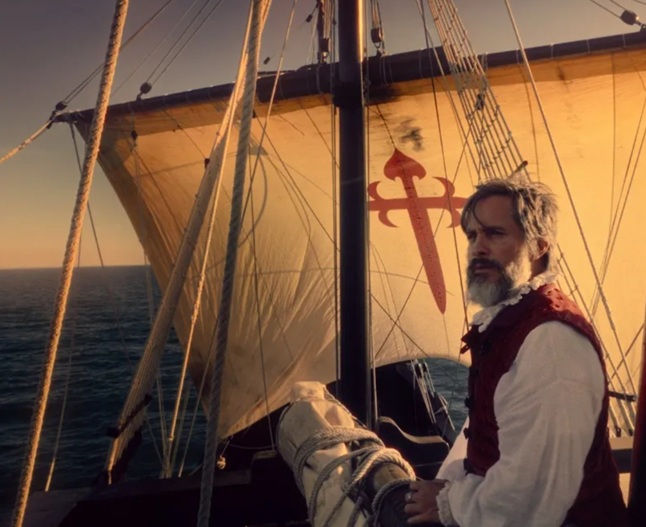
Lav Diaz cast renowned Mexican actor Gael García Bernal to follow in Magellan’s historical footsteps, marking the first time the director has worked with a non-Filipino performer. Speaking in both his native Spanish and a newly learned Portuguese, Bernal dexterously brings the man behind the myth to life through Diaz’s contemporary, indigenous prism.

To depict a world from some 500 years ago, Diaz helps that world define itself by utilizing his go-to form: “slow cinema.” What slow cinema does is create films that, in some cases, last for more than three or four hours—some even longer than that—at a time (in contrast, “Magellan” is a two-hour, 40-minute, in color, blink of an eye). By principally harnessing extended takes, Diaz stimulates viewers into looking past appearances and diligently appreciating the quotidian aspects of life, allowing for the closer consideration of reality.
Diaz’s desired effect of his version of slow cinema is to wean viewing audiences off of the baked-in, profit-driven restrictions of mass marketplace motion pictures. The director also leaves no mystery about his other desired effect: to encourage a clash of celebrated perceptions with the hard truths of the imperial legacy as it pertains to the Philippines.
“Magellan” centers on the explorer’s ambitious traversing of the Pacific Ocean in the 1500s, under the aegis of colonial pacification and Christian-sanctioned acquisition and exploitation. Magellanrolls out this crucible first across the Malay Archipelago, then in the collection of islands that would become the “Philippines.” Both landings would prove to be poisoned chalices as Magellan and his men progressively surrendered reason to passion and generated bloody paroxysms of Iberian vanity and punitive coercion.
The nationalistic nature of “Magellan” is not quite as nationalistic as one would be led to believe at first sight. Veritably, Diaz urges Filipinos to abandon the authoritative weight of canonical historical representations and ponder counterfactual narratives. Diaz willfully rocks the boat in which Filipinos understand their history. He has certainly raised eyebrows by tendering the proposal that the chieftain Lapu-Lapu was a figment of a politicized imagination.
According to Diaz, Rajah Humabon (played by Diaz’s perpetual conspirator Filipino actor Ronnie Lazaro) was responsible for spinning the foundational Lapu-Lapu story as a game changer in blunting Spanish designs.
“Magellan” has the unmistakable stamp of calling out the intemperances of empire. It follows that Diaz elevates the precolonial natives’ political and spiritual autonomy to the realm of historical consciousness.
As far as he goes to acknowledge pre-Spanish self-determination, Diaz does not articulate an era when indigenous inhabitants existed in some golden Elysium. If anything, he is keenly aware of the tangled, expedient power dynamics that imposed themselves on pre-colonial social, spiritual, and political relationships.
Lav Diaz feels his subject-matter deeply. This is more than apparent in “Magellan.” As a rigorous, close encounter with the internalized historical pathologies of imperialistic greed and lust and the resulting wounds of the colonized, “Magellan” is a movie whose time has come.