
After 80 years, descendants receive belated honors for Filipino veterans the U.S. had forgotten
By Che de los Reyes-Ferrer
All the veterans are gone now, but their families were at the Philippine Center on April 8, the eve of Araw ng Kagitingan, to honor the valor of Filipino soldiers in World War II and its echoes in modern heroism.
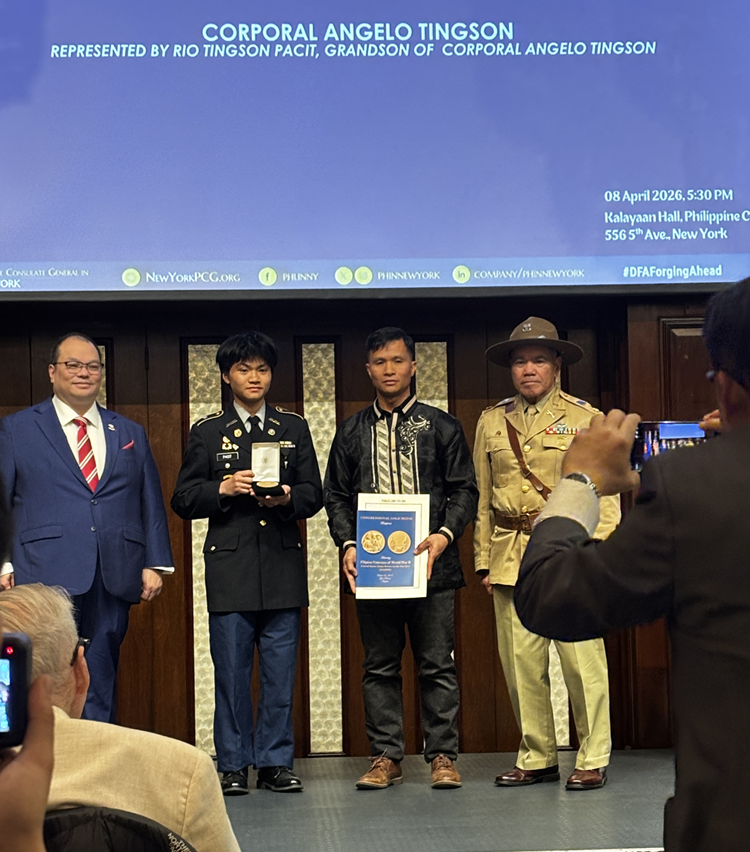
Retired Philippine Navy pilot Rio Tingson Pacit accepted the Congressional Gold Medal of Honor for his deceased grandfather, Corporal Angelo Tingson, a member of the United States Armed Forces in the Far East (USAFFE) comprising 100,000 Filipinos and 10,000 Americans in the 1940s.
A single faded certificate of that service had inspired the veteran’s son Rio Pacit to enlist, making him the first in the family to follow his Lolo’s path to military service.
“This is very important for our family and all Filipino people,” Rio Michael, the veteran’s 17-year-old grandson said. “I’m so glad great grandpa has been recognized. It doesn’t matter that it took this long — I’m just glad he got it.”
The event marked 80 years of Philippine-U.S. diplomatic ties, forged in the battles of Bataan and Corregidor, with speakers sharing gripping personal stories of the war.
Araw ng Kagitingan or Day of Valor commemorates April 9, 1942, when some 66,000 Filipino and 10,000 American soldiers surrendered in Bataan to Japanese troops after months of resistance and were forced to endure the more than 100-kilometer Bataan Death March. Thousands of Filipino and American soldiers did not make it to Capas, Tarlac, the march’s endpoint. Thousands more died as POWs at Camp O’Donnell in the months that followed.
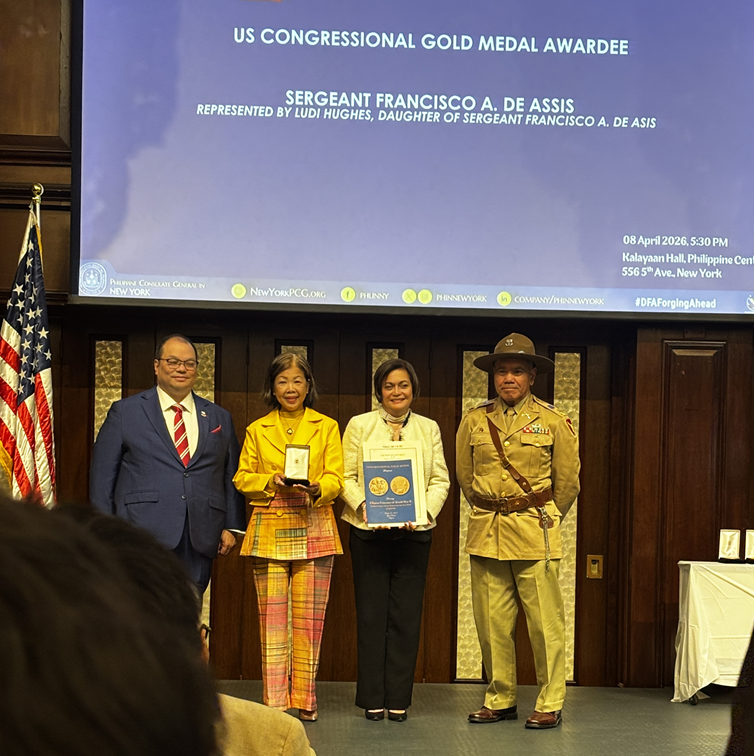
Daughter and community leader Ludi De Asis Hughes accepted the medal meant for her father Sergeant Francisco De Asis who survived the Bataan Death March.
Captain Dr. Ramon Zamora Paterno of the Armed Forces of the Philippines, who had a prominent role in establishing veteran healthcare was honored. Veteran advocate Ceres Busa and philanthropist Loida Lewis, who are close friends of the Paterno family, accepted his medal on the family’s behalf.
Another family member, David Blackledge, received the medal for his father, Captain William Clinton Blackledge of the U.S. Army. He, together with his wife, taught children in Los Baños, Laguna. Blackledge survived the Death March but later died as a prisoner of war. His son recalled being rescued by Filipino soldiers from Los Baños as a child.
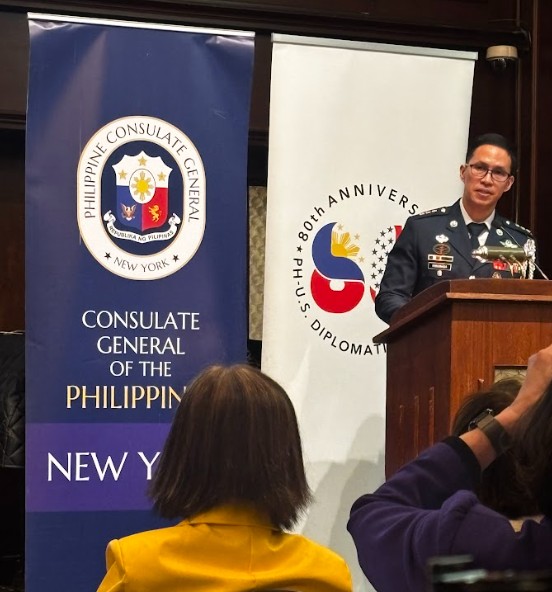
Colonel Ralph Hibionada, then a young pilot, said the Bataan Death March taught him the meaning of valor. He shared the story of the first responders during Super Typhoon Reming in Albay, Philippines in 2006. Nonstop rains and volcanic ash from recent eruptions of the nearby Mayon Volcano resulted in massive mudslides that buried entire communities.
Hibionada recalled how he watched soldiers wade in the mud – not because they were ordered to, but because people needed help. They carried children to safety, guided the elderly, then returned for more.
“Sometimes, the truest test of a soldier is not how he fights,” he said. “It is how he saves.” It was in moments like that, he said, that he came to understand what kagitingan truly means. “Kagitingan – valor – is not just courage in a single moment of battle, but the quiet decision to stand firm, again and again, despite fear, despite uncertainty, despite the cost.” He is currently a Military and Police Adviser to the Philippine Permanent Mission to the United Nations.
Consul General Senen Mangalile keynoted the event with remarks on pre-colonial roots. He said that the partnership forged in 1946 (through the PH-U.S. Treaty of Manila of 1946) was built on something older — a people who had already been fighting for their own freedom long before the two nations stood together.
“Our sovereignty is rooted in an indigenous spirit of resistance,” he said. The spirit that resisted colonization centuries earlier was the same spirit that held Bataan, he added.
The U.S. Congressional Gold Medal, Congress’s highest civilian honor, was signed into law in December 2016 to recognize Filipino WWII veterans whose promised benefits had been stripped by the Rescission Act of 1946.
Col. Sonny Busa, regional director of Filipino Veterans Recognition and Education Project (FilVetRep), shared how he lobbied Congress for years, from Nebraska to Alabama, proving Filipino valor is American history.
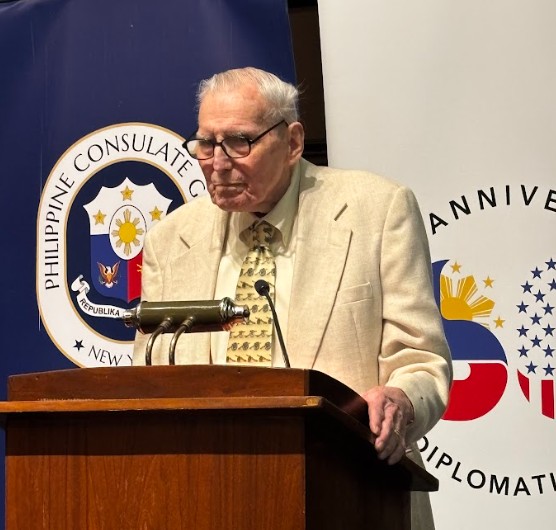
“The Filipino veterans of World War II have long been ignored,” he said. “And so for the U.S. Congress to pass a law, legislation, authorizing the gold medal is recognition that’s finally deserved.”
He elaborated that the award honors families of the roughly 260,000 who served, many deceased, while celebrating PH-U.S. ties and shared sacrifice.
Over 3,000 medals have so far been awarded in emotional ceremonies. For Busa, holding a ceremony like this one is important rather than just mailing the medal to the families.
“You have to show,” he said. “You have to tell their story.”
Che de los Reyes-Ferrer is an investigative and community-focused journalist from Manila now based in New York where she is specializing in Engagement Journalism at CUNY’s Craig Newmark Graduate School of Journalism.
